
By Professor Rizwana Chaudhri; obstetrician, gynaecologist and National Coordinator for the WOMAN Trials in Pakistan
In my clinical practice in Pakistan, I routinely encounter women who believe that heavy menstrual bleeding is desirable. This misconception is widespread across urban and rural settings, and it persists regardless of educational status.
For global health professionals working to improve menstrual and reproductive health outcomes, understanding these beliefs is essential. They shape how women interpret their symptoms, when they seek care, and how they respond to clinical advice.
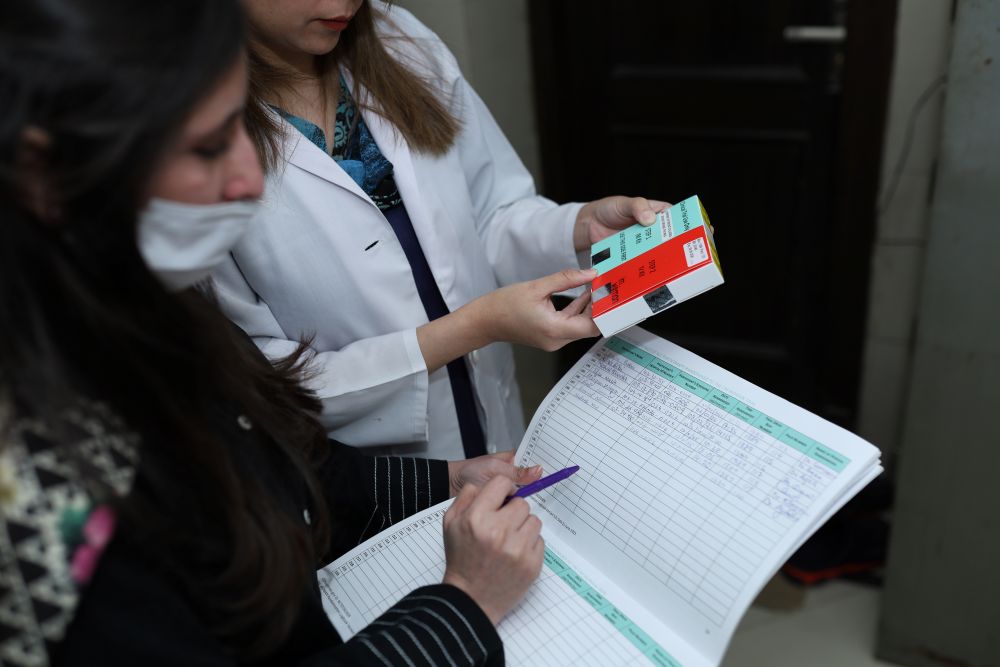
Two doctors in Pakistan work on the I’M WOMAN Trial and hold a packet of tranexamic acid.
The belief that “more bleeding is better”
One of the most pervasive ideas I encounter is the perception that menstrual bleeding cleanses the body of “impurities”. Many women express a sense of relief when their menstrual flow is heavy, interpreting it as a sign that their bodies are functioning properly. This belief extends beyond menstruation. Postpartum women routinely assume that heavier postpartum bleeding and discharge is a positive indication and are concerned when it becomes lighter.
Fertility is another related concern. Many women equate heavier periods with increased fertility, while lighter or less regular bleeding is viewed with suspicion. These assumptions influence when and why women seek help, and they often lead to delays in care even when symptoms are severe.
Anaemia and normalisation of symptoms
The normalisation of heavy bleeding contributes significantly to the high burden of anaemia among women in Pakistan. It is common to see patients with hemoglobin levels of 7–8 grams/dL who insist that their menstrual cycles are “perfectly normal”.
When I inquire further – asking about pad usage, clots, or the duration of bleeding – they are often surprised to learn that what they consider normal is, in fact, clinically concerning.
The lack of a clear understanding of the causes of anaemia complicates efforts to provide effective treatment, reduce recurrence, and support long-term health.
Stigma, silence and delayed care
Sociocultural norms surrounding modesty further inhibit timely care-seeking, especially among unmarried girls. Young women often conceal symptoms for months, relying on home remedies rather than seeking professional care. Families commonly encourage self-treatment with foods or herbal mixtures believed to promote increased bleeding, especially when periods are perceived as “too light”. These remedies, such as dates or certain spice-based mixtures, reinforce the idea that heavier flow is inherently healthier.
Even when women seek medical care for heavy menstrual bleeding, we encounter another barrier: reluctance to use pain control. Medications such as mefenamic acid, which are effective for pain, can also reduce menstrual flow. Because of the cultural preference for heavier bleeding, many women discontinue pain relief when they notice a lighter period, reinforcing monthly cycles of avoidable suffering.
Clinical understanding of heavy menstrual bleeding
From a medical perspective, normal menstrual blood loss ranges from 5–80 ml over 2–7 days. However, because most women cannot quantify blood loss, clinicians rely on indicators such as the number of pads used, bleeding that lasts longer than seven days, or the presence of clots, which is a strong sign of excessive bleeding.
In Pakistan, several common conditions drive heavy menstrual bleeding:
- Polycystic Ovary Syndrome (PCOS): Increasingly prevalent, often associated with prolonged intervals without menstruation followed by extremely heavy bleeding.
- Fibroids: A leading cause among women in their 30s and 40s.
- Adenomyosis and endometriosis: Frequently accompanied by chronic pelvic pain.
- Contraceptive methods: Copper intrauterine devices and certain hormonal injectables can increase bleeding.
- Anaemia: It is known that bleeding causes anaemia, but less well known that anaemia worsens bleeding.
- No identifiable cause: In a notable proportion of cases, investigations do not reveal a specific cause.
These clinical drivers occur against a backdrop of poor nutrition, limited awareness of iron-rich diets, and parasitic infections such as hookworm, particularly in communities without access to safe drinking water. Together, they produce a complex landscape in which anaemia is both common and under-recognised.
Implications for health practice
For health professionals, addressing heavy menstrual bleeding in Pakistan requires more than clinical intervention. It demands cultural literacy. Women’s beliefs about menstruation – what is normal, what is healthy, what signals fertility – are deeply rooted and influence how they interpret symptoms and engage with health systems.
Interventions must therefore combine treatment with culturally sensitive education. This includes promoting awareness of what constitutes abnormal bleeding, linking heavy menstruation directly to anaemia, and offering guidance on safe and effective pain management. This involves reaching people where they get their information, for example on social media or radio programmes. Strengthening access to diagnostic services, improving nutritional support, and integrating menstrual health into broader reproductive health initiatives are equally important.
The WOMAN-3 Trial
We know from the WOMAN-2 Trial that anaemia is a particular problem during pregnancy and poses a serious risk to both mothers and their babies. Anaemia increases the risk of antepartum haemorrhage, prematurity, stillbirth, neonatal death, postpartum haemorrhage and maternal death. It is therefore best to treat anaemia in young women well before they get pregnant.
Although iron and multivitamin replacement is a common anaemia treatment, iron levels in young women depend more on menstrual iron loss than on dietary intake. Menstrual bleeding has so far been overlooked in the search for new strategies to treat anaemia.
While it is well known that bleeding causes anaemia, evidence also shows that anaemia worsens bleeding. Because anaemia worsens bleeding, women with anaemia have heavier periods than they would if they were not anaemic. For these reasons, offering iron replacement without reducing menstrual iron loss may be inefficient.
The WOMAN-3 Trial, which will start recruiting participants in 2026, will investigate whether giving tranexamic acid – which reduces menstrual bleeding by preventing blood clot breakdown – with iron and vitamin replacement will be more effective in treating anaemia than iron and vitamin replacement alone.
Heavy menstrual bleeding is a clinical and cultural issue. Understanding the beliefs that shape women’s experiences is the first step toward designing effective health interventions. We hope that we can overcome these challenges to ensure that the WOMAN-3 Trial is successful and we make progress towards better health and healthcare for all women and girls.
Subscribe to our bimonthly maternal health research newsletter.