
About The Blood Trials

Giving tranexamic acid (TXA) as soon as possible and no later than 3 hours can help save the lives of trauma victims, women after childbirth, and also reduces bleeding in patients undergoing surgery.

But what is TXA and how does this drug actually work?
Our TRIALS

The history of TXA

While Japan struggled to recover from the devastation of World War II, husband and wife researchers, Dr Utako and Dr Shosuke Okamoto, were making medical history.

Their research was driven by the desire to reduce death from haemorrhage, especially as death after childbirth from bleeding was a major killer of women in Japan at that time. They were so committed to their research that they worked on blood drawn from their own veins.

In September 1962, they reported in the Keio Journal of Medicine the invention of a new chemical entity called Epsilon-aminocaproic acid (EACA) that inhibited the enzymatic breakdown of fibrin by plasmin, a process called fibrinolysis. This is important because uncontrolled plasmin can rapidly deplete the body’s fibrinogen, which can lead to haemorrhaging.

Later, the Okamotos developed a much more potent form of the drug, tranexamic acid or TXA. TXA’s potential to reduce death from bleeding would not be recognised for decades.

Even today, with substantial evidence, TXA remains underused and undervalued for many reasons, for example a lack of awareness with healthcare professionals, as well as a lack of affordability and accessibility in low- and middle-income countries where the benefit would be greatest. Tranexamic acid is a generic, non-patented drug that lacks financial backing from private companies.

Watch this video to find out more about the history of TXA:

How did the Okamotos discover TXA?

The couple knew that there was an enzyme in the blood called plasmin that breaks down fibrin clots and they wanted to find a drug that would inhibit its action to reduce excessive bleeding.

They started out by screening amino acids and found lysine to be highly effective at inhibiting the breakdown of fibrin.

Then they removed an amino group from the lysine molecule. This increased its potency and led to the discovery of the first in a new class of antifibrinolytic drugs: Epsilon- Amino-Caproic Acid (EACA) was created.

After more research, they discovered tranexamic acid, which was 27 times more powerful than EACA.

What is TXA and what does it work?

TXA is a drug that helps prevent or reduce bleeding by slowing down the breakdown of blood clots. If cut or injured, your body normally forms blood clots to stop the bleeding. Once the clot is no longer needed, the body breaks it down. TXA blocks the process that breaks down these clots too quickly, helping to keep the clot intact and stop further bleeding.

It’s commonly used in situations where there’s a risk of excessive bleeding, like during surgery, heavy periods, or in traumatic injuries. By keeping the clots intact, TXA helps control bleeding more effectively.

TXA must be given quickly to save lives

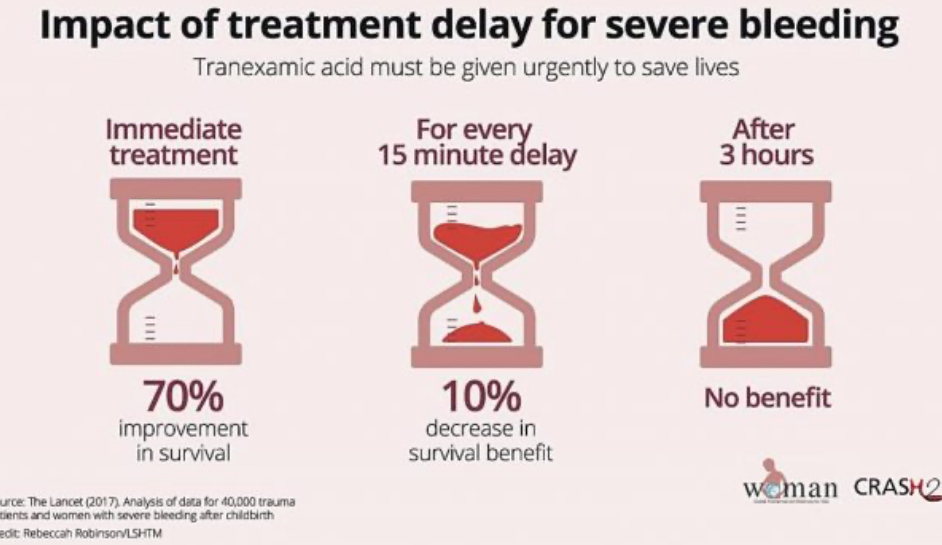
Giving tranexamic acid as soon as possible, and no later than three hours, will help save the lives of trauma victims and women after childbirth, as well as reducing bleeding in patients undergoing surgery.

This graph shows the analysis of data for 40,000 trauma patients and women with severe bleeding and the impact of treatment delay in giving TXA.

For every 15-minute delay, there is a 10% decrease in survival benefit.

TXA’s remarkable inventor

Dr Utako Okamoto began her career in 1936 studying dentistry but soon changed to medicine in 1942 where she found her life’s passion and was inspired to give back to humanity. 

Unfortunately, her early career was not easy as medicine and medical research were profoundly male dominated fields.

She was once asked to leave a conference on the grounds that medical conferences were not for women and children, and when she first presented her research, she was ridiculed.


Dr Utako lived to see the beginning of the WOMAN Trial in 2010, which recruited over 20,000 women in four countries to assess the effectiveness of TXA in treating postpartum haemorrhage. Sadly, Utako died before its completion in 2016.

The publication of the WOMAN Trial results in 2017 confirmed her original prediction. The trial provided evidence that TXA can reduce the risk of death due to postpartum haemorrhage by one-third.

Want to hear from us?

Sign up to our trial newsletters and get the latest information on our trials.
Menu