
A paper published today in The Lancet Global Health puts forward an innovative model for identifying women who are at the highest risk of death or a near-miss while giving birth.
The paper – from a group of authors based at the University of Lausanne, the London School of Hygiene & Tropical Medicine (LSHTM) and institutions in Nigeria, Pakistan, Tanzania, Zambia and France – used data from over 40,000 women across four trials in low-, middle- and high-income countries to develop the model that could have significant clinical impact.
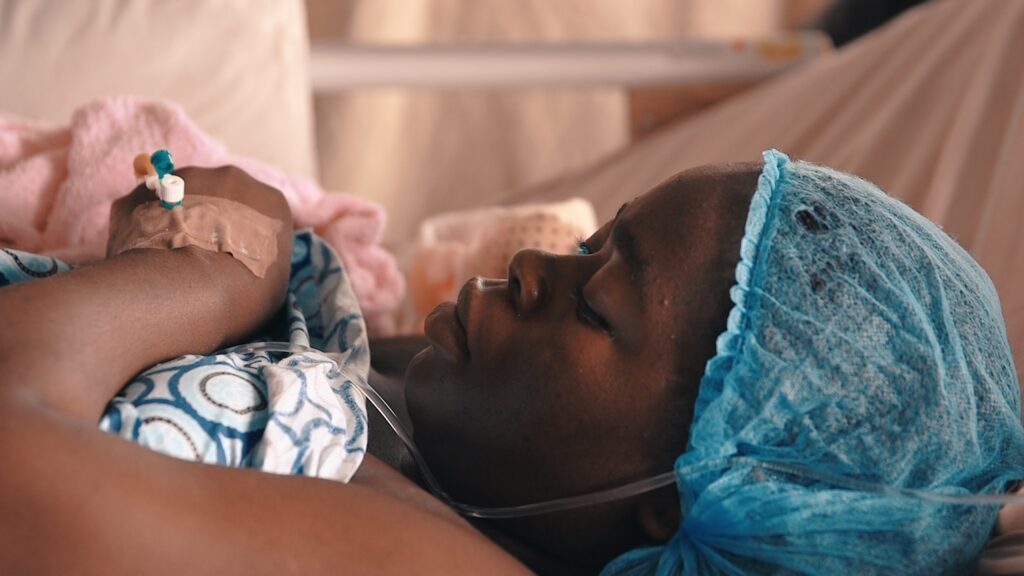
A woman lies in a hospital bed on a maternity ward.
Around 70,000 women every year die from severe bleeding during or after childbirth – often referred to as postpartum haemorrhage (PPH). Although an effective treatment for PPH exists – a drug called tranexamic acid (TXA) that is proven to reduce bleeding – women are often diagnosed or treated too late.
This is particularly true for women with anaemia, who can become seriously ill after losing an amount of blood way below the World Health Organization’s (WHO) diagnostic criteria for PPH, which has been recently revised down from 500ml to 300ml of blood loss.
Given that in sub-Saharan Africa and South Africa, where most maternal deaths happen, over half of pregnant women are anaemic, having an alternative strategy for identifying women at high risk of death and near miss due to bleeding after birth, could be hugely significant.
Dr François-Xavier Ageron, Department of Emergency Medicine, Lausanne University Hospital, Switzerland, and lead author of the paper, said: “All other models try to predict PPH based on blood loss or the need for a blood transfusion. This is the first that looks at the outcomes that matter to women, which are death and near misses.
“This new model focuses on the outcomes that matter most, predicting the risk of death or life-threatening bleeding rather than blood transfusion, which often depends on availability and is frequently not an option in low- and middle-income countries.
“By taking anaemia into account, it avoids the bias of existing models, which is critical given that almost half of all women giving birth in some low- and middle-income countries are anaemic. We therefore strongly believe this model should inform WHO guidelines going forwards.”
To develop the model, the study looked at data from over 40,000 women with a mix of characteristics, including PPH diagnosis, moderate and severe anaemia, as well as vaginal and caesarian births, and single and multiple pregnancies. To control for the variations in the data, the authors used a statistical method that takes account of differences between studies and countries, recognising that results can vary depending on location of data and by trial.
The risk factors included in the final model were age, blood pressure, anaemia severity, caesarean section, placenta abnormality, high blood pressure during pregnancy, and stillbirth. Deaths were considered within 24 hours of giving birth, and near misses were cases where women needed major surgery or urgent procedures to stop the bleeding within the first day after birth.
Each risk factor was given a simple points score based on how strongly it was linked to serious outcomes in the final model. It was tested based on how accurately it identified women who did, and did not, have life-threatening complications.
Using this score, women were grouped into clear risk levels: very unlikely (less than 1% risk), low risk (1–4%), medium risk (5–9%), high risk (10–19%), and very high risk (20% or higher). For example, women younger than 30 with no risk factors have a score of 0.
The study also looked at how well the score performed in different countries and combined the results to see how accurate and reliable it was overall. The paper shows that the model accurately predicts death or near-miss from bleeding after birth. The model can identify high-risk women where the benefits from early intervention – such as administration of TXA – are the greatest.
Dr Ageron said: “Because our score is based on information available at admission, it allows clinicians to quickly identify high-risk patients and intervene earlier, particularly in low- and middle-income settings.
“Although the accuracy of our model in high-income countries requires further research, the benefits of TXA administration at the time of birth are also much less clear in these settings. In women at high risk, the balance of benefits and possible harms is clearly favourable and TXA treatment at the time of birth is likely to be effective and cost-effective, and most importantly, save lives.”
Publication
François-Xavier Ageron, Katharine Ker, Danielle Prowse, Ewout W Steyerberg, Eni Balogun, Haleema Shakur-Still, Folasade Adenike Bello, Hugo Madar, Catherine Deneux-Tharaux, Rizwana Chaudhri, Oladapo Olayemi, Projestine Muganyizi, Loïc Sentilhes, Ian Roberts, for the Antifibrinolytics Trialists Collaborators Obstetric Group. Early assessment of maternal bleeding: development and validation of a prognostic model predicting death and near miss, The Lancet Global Health 2026. DOI: 10.1016/S2214-109X(25)00488-7
Funding
This study was funded by the Gates Foundation (investment ID INV-007787).