

Researchers from the WOMAN Trials team respond to a major review on the causes of postpartum haemorrhage that was published in The Lancet.
The paper by Idnan Yunas and colleagues – Causes of and risk factors for postpartum haemorrhage: a systematic review and meta-analysis – which was published in The Lancet in April 2025, set out to clarify the main causes of postpartum haemorrhage (PPH).
The authors reviewed hundreds of population-based cohort studies, covering data from more than 800 million births globally. Their analysis concluded that around 70% of PPH cases are attributed to uterine atony, meaning the uterus does not contract effectively after birth. They also identified anaemia as a strong risk factor for PPH, alongside others such as previous PPH, caesarean birth, multiple pregnancy, and placenta praevia.
Findings reinforced current thinking on PPH and anaemia
Based on these findings, the authors reinforced current clinical guidance that focuses on preventing and treating uterine atony, including the routine use of uterotonic drugs to help the uterus contract after delivery. They argued that identifying women at higher risk allows for better planning and prevention, but that uterine atony remains the dominant cause of PPH across settings.
In response to this paper, researchers from the WOMAN Trials team have published two letters, challenging both the interpretation of the evidence and some of the conclusions drawn.
The relationship between low haemoglobin and bleeding
In the first letter published on 3 January 2026, Raoul Mansukhani – a statistician for the WOMAN Trials – and colleagues focused on anaemia. They noted that the paper did not include the WOMAN-2 cohort study, a large and recent study of more than 15,000 women with moderate or severe anaemia giving birth in sub-Saharan Africa and South Asia, where most maternal deaths occur.

As detailed previously, this study found that lower haemoglobin levels before birth were strongly linked to a higher risk of PPH. The authors of the letter argued that this strong and consistent relationship, combined with accurate measurement of haemoglobin before bleeding began, suggests that anaemia should be considered a cause of PPH rather than just a risk factor.
They questioned the practice of labelling uterine atony as the cause when it is often diagnosed only after bleeding has started. Given the very high global prevalence of anaemia among women, they argued that greater emphasis should be placed on preventing anaemia as a way to reduce PPH.
The evidence on uterine atony
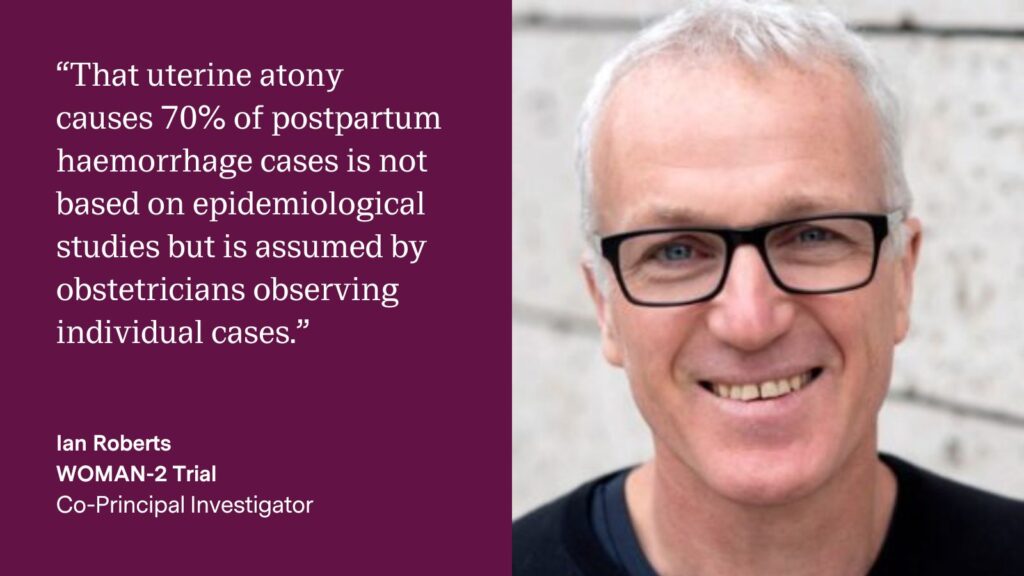
The second letter published at the same by Professor Ian Roberts – the co-lead of the WOMAN Trials – challenged the idea that uterine atony can be confidently identified as the cause of most PPH cases. He argued that uterine tone was rarely, if ever, measured accurately in the studies included in the review, and that the diagnosis of uterine atony is often based on assumption rather than objective measurement.
He pointed out that epidemiology usually identifies causes by comparing outcomes in people who are exposed to a factor and those who are not, and that this type of evidence is largely absent for uterine atony. He also warned against assuming that because uterine atony is believed to cause PPH, giving uterotonic drugs to all women must therefore improve outcomes. Drawing parallels with past medical errors, he argued that widely accepted theories can be wrong.
In their response published in the same issue, Yunas and colleagues defended their conclusions by referring to established principles for judging causation. They cited recent prospective research in which uterine tone was measured using a validated scoring system and shown to be strongly linked to later severe bleeding and the need for blood transfusion.
They argued that uterine atony meets multiple criteria for a causal relationship, including timing, biological explanation, dose–response effects, and evidence from trials showing that uterotonic drugs reduce the risk of PPH.
They rejected the claim that anaemia should be considered a direct cause of PPH, noting that most anaemic women do not experience PPH and that PPH rates are similar in countries with low and high levels of anaemia. While acknowledging that anaemia increases risk, they argued that this does not make it a cause.
Managing anaemia in women of reproductive age is crucial to maternal health
This exchange highlights the ongoing and important scientific debate about how causes of PPH are defined, measured and prioritised, and about where prevention efforts should be focused to reduce maternal deaths worldwide.
Previously published analyses from the WOMAN-2 Trial showed that the risk of PPH increases steadily as the severity of anaemia worsens.
New findings, due to be published later this year, show that women with severe anaemia are more likely to become critically unwell and are less able to tolerate the physical demands of childbirth, regardless of the amount of blood lost, compared with women with moderate anaemia.
Together, these findings underline the need for better prevention, detection and treatment of anaemia among women of reproductive age to improve maternal outcomes.