
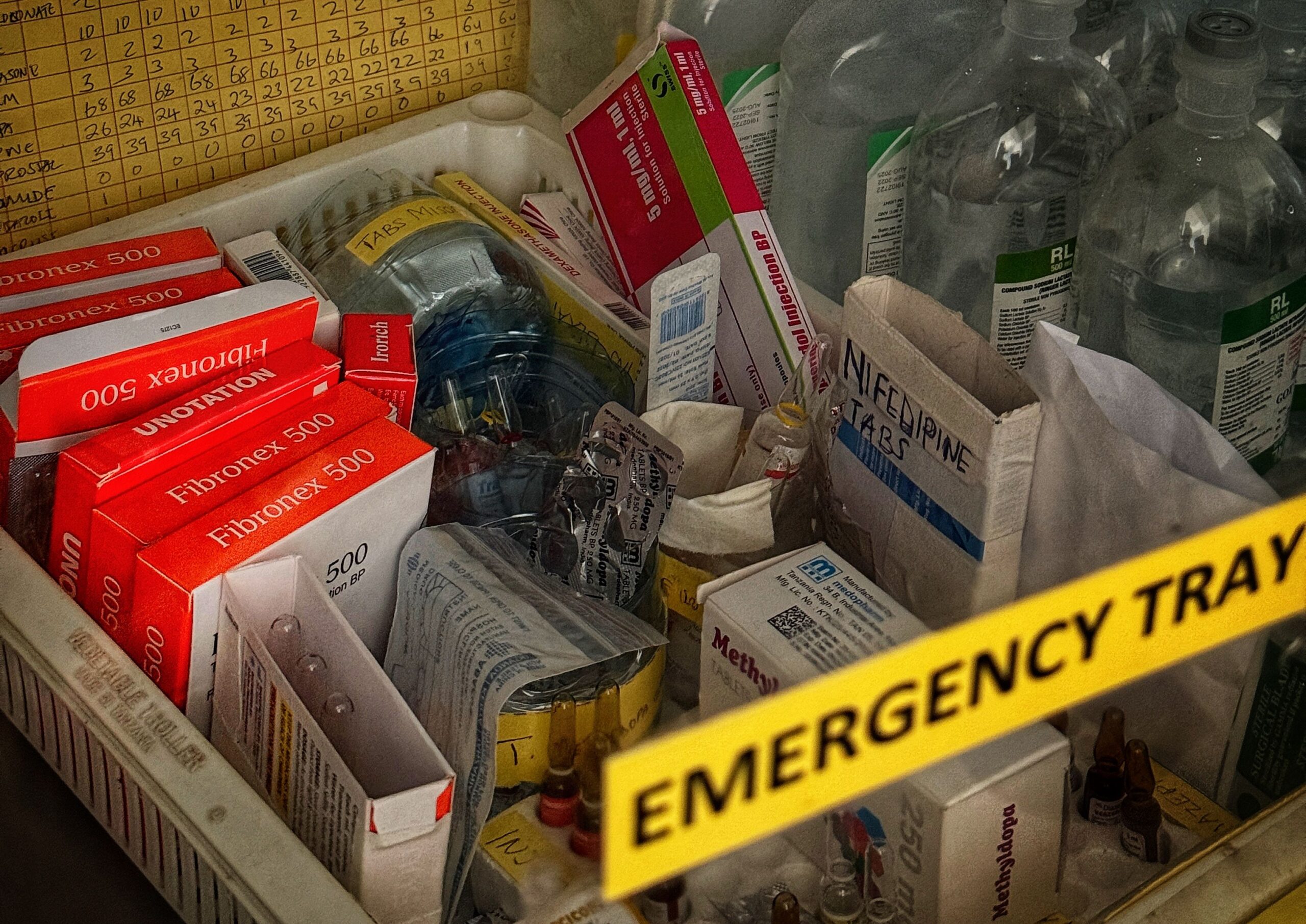
Emergency tray supplies at an obstetrics and gynaecology hospital ward in Tanzania. Credit: the I’M WOMAN Trial.
A new study of more than 15,000 births in Nigeria, Pakistan, Tanzania and Zambia found that only around one in ten women received pharmacological pain relief.
Those who did were a third less likely to have a postpartum haemorrhage, or severe bleeding after childbirth, compared to those who had no pain relief.
The findings, published in the International Journal of Gynecology & Obstetrics, are based on data from the WOMAN-2 Trial, an international clinical trial coordinated by the London School of Hygiene & Tropical Medicine.
Of the 15,068 women with moderate or severe anaemia who gave birth vaginally in hospitals in Nigeria, Pakistan, Tanzania and Zambia, only 12% received pharmacological pain relief during labour. This is despite World Health Organization (WHO) guidance recommending that pain relief be available to all women who request it.
These findings support the need for further research into whether pain management could offer an additional way to protect women with anaemia from the negative consequences of blood loss, including death.
Dr Judith Lieber, Assistant Professor at LSHTM and lead author of the paper, said: “Pain relief can make childbirth a more positive experience for mothers, making it a key part of the concept of respectful maternity care. It should be available to all women, while recognising each individual’s right to make an informed decision about whether she wants it.”
“Our findings suggest that pain relief – as well as reducing pain – could also reduce postpartum haemorrhage. This is hugely important because postpartum haemorrhage is reported as the leading cause of maternal death worldwide.”
Findings relevant to lower-resource settings
This is the first study to examine the association between postpartum bleeding and the types of pharmacological pain relief more commonly available to women giving birth in lower-resource settings.
The data showed that 8.9% of the women received opioids, while fewer than 0.1% received an epidural. An epidural is an injection that is given near the spine by anaesthetists. There is a shortage of these specialised clinicians in many hospitals across sub-Saharan Africa and South Asia.
Previous evidence linking pharmacological pain relief to lower postpartum blood loss has come from studies in high-income countries that focused on regional anaesthesia, which includes epidural.
If future research establishes that opioids – which are more accessible in lower-resource settings – directly reduce postpartum bleeding, their appropriate use could potentially improve maternal outcomes in regions where most deaths related to bleeding occur.
Wide variation in access to pain relief
The use of pharmacological pain relief varied substantially between the countries and hospitals included in the WOMAN-2 Trial.
Pain relief was given to almost 15% of women in Pakistan, compared with fewer than 1% in Tanzania. At hospital level, the proportion of women receiving pain relief ranged from zero in some facilities to 100% in others.
The low overall use of pain relief also contrasts with practice in many high-income countries, where most women receive some form of pharmacological pain relief during labour, with reported use as high as 90% in some settings.
The reasons for low use in lower-resource settings are complex. They may include shortages of medicines, limited numbers of trained staff, concerns about side effects, low awareness of available options, ability to pay, and differences in provider attitudes. Women may also choose not to use pharmacological pain relief, due to concerns on the potential side effects of some medications.
Lower odds of postpartum haemorrhage
Postpartum haemorrhage is widely reported as the leading cause of maternal death worldwide. Women with anaemia are especially vulnerable to PPH as their blood has a reduced capacity to carry oxygen, leaving them less able to tolerate further blood loss.
In the study, calculated postpartum haemorrhage occurred in 6.3% of women who received pain relief, compared with 9.9% of those who did not. The researchers calculated the total blood that women lost by comparing their haemoglobin level before and after birth. As haemoglobin is carried by red blood cells, bleeding causes levels to drop. After researchers accounted for a wide range of factors that might affect bleeding risk, pain relief was associated with 36% lower chance of calculated postpartum haemorrhage.
One possible explanation for the association is that controlling pain reduces the body’s stress response during labour. Pain, fear, and physical trauma can increase adrenaline levels, which may affect the body’s ability to maintain blood clots and could worsen bleeding. The WOMAN-2 Trial did not collect this data, so it could not be tested directly.
Pain relief during obstetric procedures
The study recorded low use of pain relief among women who had an episiotomy or an instrumental birth, procedures for which local or regional anaesthesia is recommended.
Previous research from the same team published in The Lancet Global Health showed that having an episiotomy, a surgical cut to the vagina during childbirth, doubles the risk of PPH in women with moderate or severe anaemia,
However, information about local anaesthetic use was not collected in the same systematic way as information about opioids and epidurals, meaning it may have been under-recorded.
Professor Rizwana Chaudhri, an obstetrician and head of the WOMAN Trials in Pakistan said:
“In Pakistan, we believe that all women undergoing episiotomy at participating sites received local anaesthetic, despite the lower levels shown in the dataset. We should be cautious about concluding that these procedures were routinely performed without pain relief.
“However, changes may need to be made to the number of episiotomies performed given the overall trial data and WHO recommendations.”
A shift towards more respectful care
Further research is needed to determine whether pharmacological pain relief, particularly opioids, directly reduces postpartum bleeding.
However, the findings highlight substantial inequalities in access to pain management during childbirth and identify an important area for future maternal health research and clinical practice.
Professor Chaudhri said: “As obstetricians, we must change practice by adhering to evidence-based guidelines, strengthening training, and championing respectful maternity care that empowers every woman to make informed choices about pain relief in childbirth.”
Publication:
Pharmacological pain relief and postpartum bleeding in women with moderate or severe anaemia: A cohort analysis of the WOMAN-2 trial, International Journal of Gynecology & Obstetrics
The WOMAN-2 Trial Collaborators