
New study highlights importance of preventing and treating maternal anaemia to reduce number of newborns at increased risk of health complications.
Almost 40% of mothers with moderate or severe anaemia gave birth to babies born prematurely, with low birth weight, or smaller than expected for their gestational age, according to new research from the London School of Hygiene & Tropical Medicine.
The study, published in the International Journal of Gynecology & Obstetrics, analysed data from 14,444 women* with moderate or severe anaemia in Nigeria, Pakistan, Tanzania and Zambia, who took part in the WOMAN-2 Trial coordinated by LSHTM’s Clinical Trials Unit. Of these women, 5,703 gave birth to a small vulnerable newborn, with those with more severe anaemia more likely to give birth to these babies.
Small vulnerable newborns are babies who are born prematurely, have low birth weight, or are smaller than expected for their gestational age. They are at increased risk of dying in their first weeks of life and can experience short- and long-term health complications, including infections, breathing difficulties and neurodevelopmental problems.
Read the full story on the LSHTM website
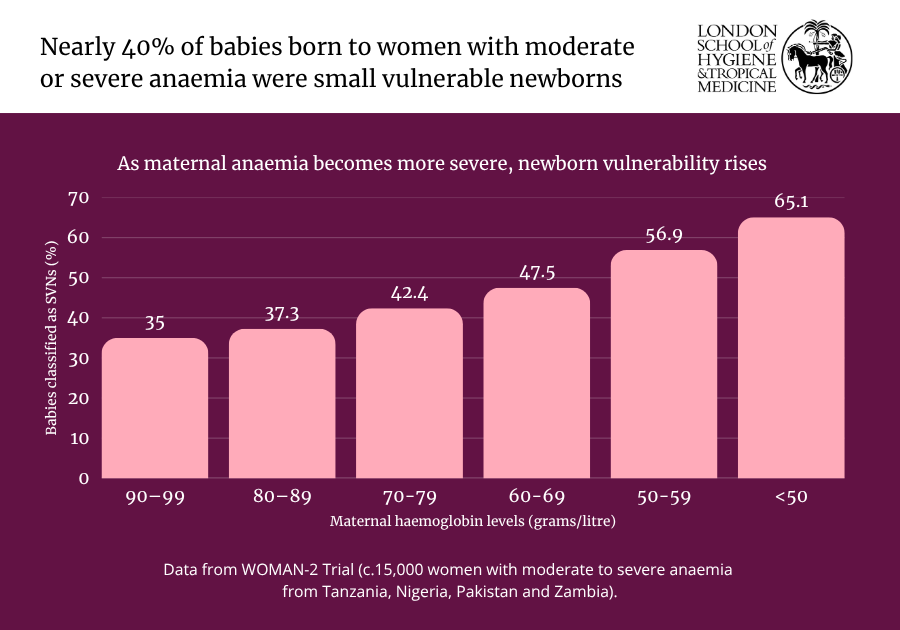
As maternal anaemia becomes more severe, newborn vulnerability rises
Publication
Ochola et al. Severity of maternal anaemia and the risk of giving birth to a small vulnerable newborn: A cohort analysis of the WOMAN-2 trial in four countries. International Journal of Gynecology & Obstetrics. 2026 DOI: https://doi.org/10.1002/ijgo.71306
Subscribe to our bimonthly maternal health research newsletter.