
10,000 women could be saved every year if they had access to and were given the drug tranexamic acid (TXA) during childbirth, new research published in The Lancet Global Health shows.
However, TXA – a commonly used drug to reduce bleeding – is not affordable in the settings where it could have the greatest impact, raising serious questions about how it can be financed and used cost-effectively. Indeed, the study shows that TXA is unaffordable in 40% of countries that would see its benefit.
Severe bleeding during or after childbirth, also known as postpartum haemorrhage (PPH), causes around 70,000 deaths worldwide each year. The vast majority of these deaths occur in sub-Saharan Africa and South Asia.
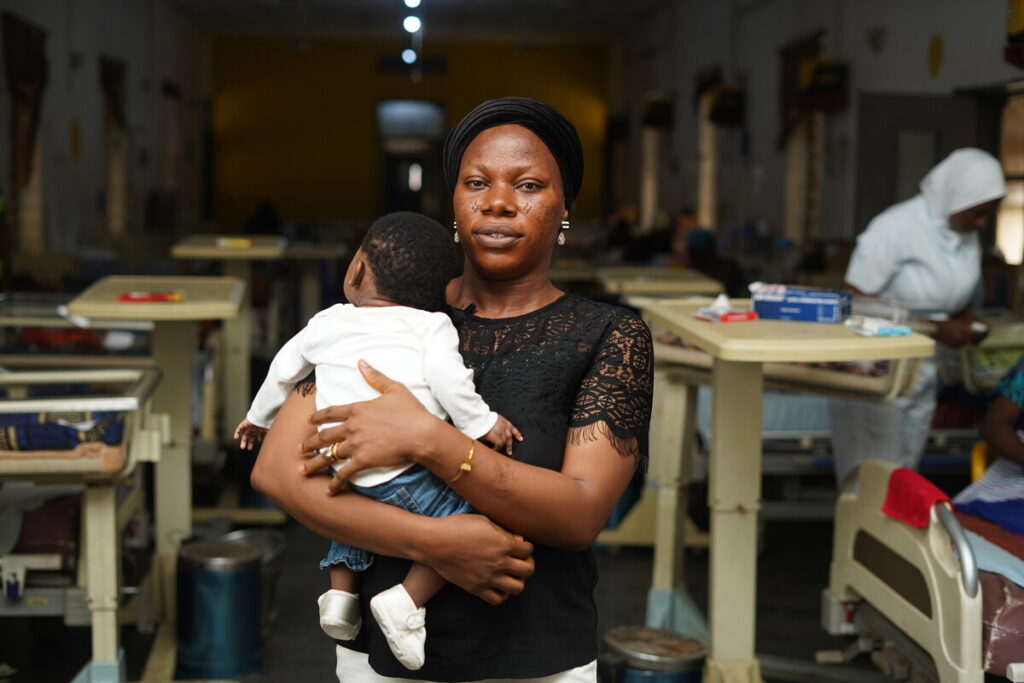
A woman on a maternity ward in Nigeria holds her baby close to her chest.
The World Health Organization (WHO) recommends giving TXA to all women with a PPH within three hours of birth. This means women receive the drug once bleeding has already started. However, for women who are at high risk of death from bleeding, such as women with anaemia, this can be too late.
This research aimed to identify the countries where giving TXA to all women at the time of birth would cost-effectively reduce maternal deaths.
The study was led by the London School of Hygiene & Tropical Medicine (LSHTM) and collaborators in Nigeria, Pakistan, Tanzania, Zambia, France and the USA. It used WHO data on death rates and estimates from an individual patient data (IPD) meta-analysis, which includes data from five trials and over 50,000 women.
The IPD meta-analysis, conducted by the same team and published in The Lancet in 2024, showed that TXA reduced the risk of life-threatening bleeding by nearly one quarter.
This new study found that giving TXA to all women giving birth is beneficial and cost-effective in countries with 20 PPH deaths or more per 100,000 births. Researchers estimate that thousands of deaths could be prevented at a cost equivalent to around US $5* per woman.
Researchers estimated the benefit of TXA by looking at deaths avoided. One dose of TXA (1 gram) was assumed to be equivalent to around US $5*. The health benefits were estimated based on how much each country can afford to spend on healthcare, using average income levels.
Dr Katharine Ker, Assistant Professor at LSHTM’s Clinical Trials Unit and co-lead author of the study said:
“No one should die from postpartum haemorrhage. Women are still bleeding to death after giving birth, even though we have an effective treatment. TXA saves lives, and women everywhere must be able to access it. We need a global effort, involving governments and international bodies, to ensure that affordable TXA is available in every country.
“TXA could also have important benefits beyond preventing death, including reducing severe bleeding and blood transfusions, avoiding postpartum anaemia and improving women’s wellbeing. These potential benefits matter for women in all settings, including high-income countries. We are planning a new trial to assess these benefits, which, if proven, could further expand the settings where TXA helps women and makes childbirth safer.”
The study also identified the countries where the greatest number of lives could be saved every year by giving TXA to all women giving birth, with Nigeria and India at the top with about 2,700 and 1,100 lives saved every year respectively.

Conversely, in a lot of high-income countries where TXA is affordable and accessible, PPH deaths are relatively rare, and it is unclear whether routinely using TXA provides additional benefit.
The findings apply to countries overall, not to individual women, but they still have important implications for national decisions about supplying and using the drug.
Ziyi Lin, Research Fellow at LSHTM’s Global Health Economics Centre and co-lead author of the paper, said:
“These findings are a deviation from the current WHO recommendation. Currently, TXA is recommended once a woman has started to bleed excessively after birth. We hope that this new evidence will encourage a review of the WHO recommendations for TXA and that its use for all women giving birth in the countries where it will have the most impact will become standard practice.”
“The data show that giving TXA at the time of birth would save thousands of lives each year and make an important contribution to achieving the Sustainable Development Goal of reducing maternal mortality. In the paper, we include maximum prices for TXA to be cost-effective by country and hope that these will be used by policymakers to inform targeted strategies, such as subsidy programmes, bulk procurement agreements or price negotiations.”
* To compare costs fairly across countries, economists use “international dollars” (Intl$), which adjust for purchasing power. It represents what the US dollar could buy in the United States in 2021. Using this measure, 1 gram of TXA was priced at Intl$ 4.65 for this study. The purchasing power parity rates used are publicly available from the WHO website.
Publication
The effect of tranexamic acid during childbirth on maternal mortality: an epidemiological modelling and cost-effectiveness study, The Anti-fibrinolytics Trialists Collaborators Obstetric Group, The Lancet Global Health, DOI: 10.1016/S2214-109X(25)00521-2
Funding
The WOMAN-2 Trial is funded by the Bill & Melinda Gates Foundation (INV-007787) and the Wellcome Trust (WT208870/Z/17/Z).
Subscribe to our bimonthly maternal health research newsletter.