

By Professor Ian Roberts, co-lead of the WOMAN Trials
Every year, millions of patients undergoing surgery around the world are exposed to avoidable bleeding and unnecessary blood transfusions, despite there being a safe and effective intervention – tranexamic acid (TXA).
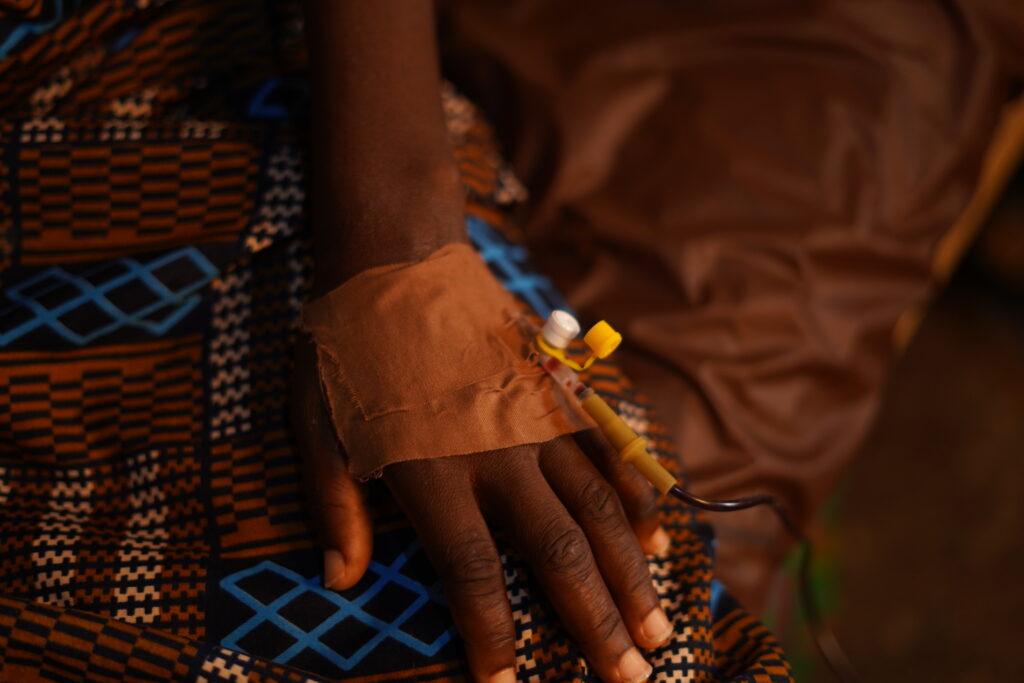
A woman with a cannula in her hand receives a blood transfusion.
The evidence is overwhelming: a single dose of tranexamic acid given before surgery safely reduces bleeding and lowers the need for blood transfusion. The real problem is implementation.
That is why Professor Michael Murphy and I argue in a recent New England Journal of Medicine editorial that tranexamic acid should be added to the WHO Safe Surgical Checklist.
TXA reduces bleeding if given before surgery
There is very strong evidence from large, high-quality randomised trials that a single dose of tranexamic acid just prior to surgery safely reduces bleeding. Indeed, in the UK, the National Institute for Health and Care Excellence (NICE) already recommends tranexamic acid for all patients undergoing surgery in hospital where there is any risk of bleeding. Yet despite this guidance, uptake remains inconsistent.
The most recent evidence comes from the Canadian TRACTION trial, also published in the New England Journal of Medicine. The study involved more than 8,000 patients undergoing major non-cardiac surgery across 10 hospitals. It found that a hospital-wide policy of administering tranexamic acid reduced red-cell transfusions by around 25%, without increasing venous thromboembolism risk.
The rate of thrombotic events was identical in the TXA and placebo groups. This study provides yet more evidence that TXA safely reduces bleeding without increasing thrombosis risk.
Addressing the fear of thrombosis
Importantly, the TRACTION trial addressed one of the lingering concerns that has slowed wider adoption of TXA in surgery: fears about thrombosis. These concerns have persisted despite systematic reviews involving close to 100,000 patients showing no evidence of increased thrombotic risk.
The Canadian investigators included large numbers of patients undergoing oncological surgery – a population often considered at higher baseline risk of clotting complications – and still found TXA to be safe.
How this applies to reducing maternal deaths
For obstetricians, this evidence should resonate strongly. We already know from the WOMAN Trial that tranexamic acid reduces death due to bleeding in postpartum haemorrhage when given promptly after childbirth.
As well as better outcomes for mothers and their babies, it also reduces the need for transfusions, which is particularly significant in low- and middle-income countries where access to blood products can be limited and transfusion-related risks remain significant.
But the implications go beyond maternity care. Surgical bleeding remains a major cause of preventable death across all specialties. Around one in 65 patients undergoing major non-cardiac surgery experiences perioperative bleeding, and outcomes can be devastating. Blood transfusion can of course be lifesaving, but it is also a scarce resource associated with substantial costs and risks.
Wider TXA use reduces exposure to risks from transfusion
In many lower-resource settings, wider use of tranexamic acid could deliver especially important benefits. Tranexamic acid is a stable and easy to administer drug. Its use in surgery is cost-effective even where resources are severely constrained.
As well as improving patient outcomes, wider TXA use would reduce exposure to transfusion-related complications, including HIV, hepatitis B and hepatitis C, alongside risks posed by newly emerging infections.
The WHO Safe Surgical Checklist has been one of the most successful patient safety interventions in modern medicine. By standardising simple but evidence-based practices, it has improved communication, reduced complications and saved lives worldwide. Including tranexamic acid on the checklist would be a logical next step.
Implementation science tells us that clinicians are more likely to adopt interventions when they are embedded into routine systems and workflows. Checklists are powerful because they normalise good practice. We have already seen how surgical safety checklists transformed antibiotic prophylaxis and pulse oximetry uptake. TXA should follow the same path.
Patient safety should be prioritised
No single intervention will eliminate surgical or postpartum bleeding, but few treatments in modern medicine offer such a compelling combination of effectiveness, safety, simplicity, and relative affordability.
Adding tranexamic acid to the WHO Safe Surgical Checklist would demonstrate that reducing avoidable bleeding is a patient safety priority. More importantly, it would help ensure that patients everywhere benefit from a safe and effective drug which is proven to save lives.
Subscribe to our bimonthly maternal health research newsletter.